- English
- French
- German
- Portuguese
- Spanish
- Russian
- Japanese
- Korean
- Arabic
- Greek
- German
- Turkish
- Italian
- Danish
- Romanian
- Indonesian
- Czech
- Afrikaans
- Swedish
- Polish
- Basque
- Catalan
- Esperanto
- Hindi
- Lao
- Albanian
- Amharic
- Armenian
- Azerbaijani
- Belarusian
- Bengali
- Bosnian
- Bulgarian
- Cebuano
- Chichewa
- Corsican
- Croatian
- Dutch
- Estonian
- Filipino
- Finnish
- Frisian
- Galician
- Georgian
- Gujarati
- Haitian
- Hausa
- Hawaiian
- Hebrew
- Hmong
- Hungarian
- Icelandic
- Igbo
- Javanese
- Kannada
- Kazakh
- Khmer
- Kurdish
- Kyrgyz
- Latin
- Latvian
- Lithuanian
- Luxembou..
- Macedonian
- Malagasy
- Malay
- Malayalam
- Maltese
- Maori
- Marathi
- Mongolian
- Burmese
- Nepali
- Norwegian
- Pashto
- Persian
- Punjabi
- Serbian
- Sesotho
- Sinhala
- Slovak
- Slovenian
- Somali
- Samoan
- Scots Gaelic
- Shona
- Sindhi
- Sundanese
- Swahili
- Tajik
- Tamil
- Telugu
- Thai
- Ukrainian
- Urdu
- Uzbek
- Vietnamese
- Welsh
- Xhosa
- Yiddish
- Yoruba
- Zulu
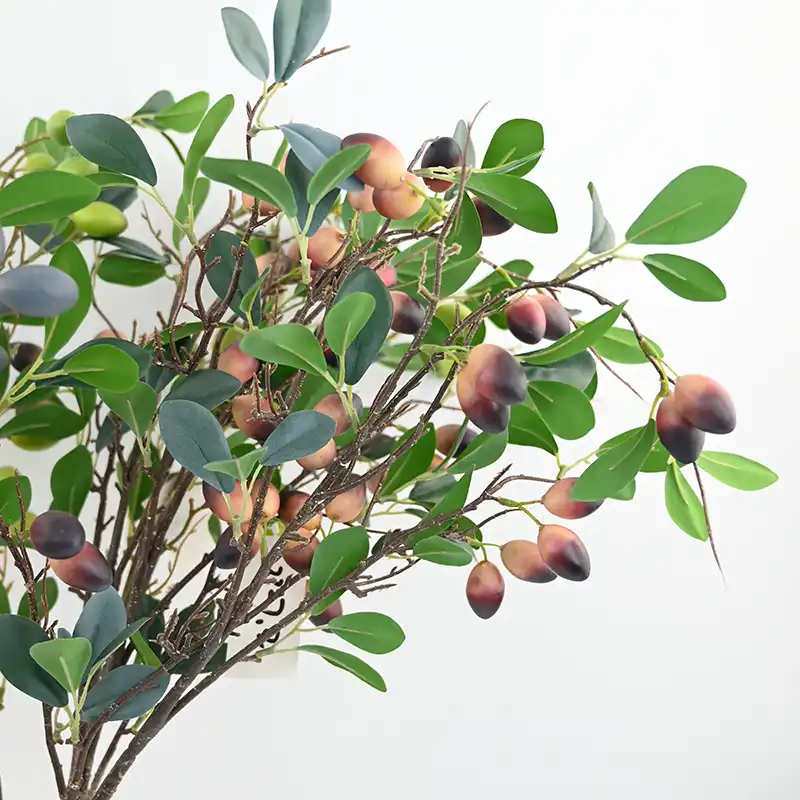
Realistic standards are reached by using cutting-edge production techniques to make the artificial olive branch fit for business use. Today's high-end artificial olive branches are made from advanced silk and PE materials, and they look just as real as real ones thanks to careful shaping, hand-painting, and plant observation. The 97 cm artificial olive branch is a great example of this change. It has oval, leathery leaves that are shiny and deep green on the outside with clear vein patterns and fruits that change colour from green to reddish-brown and blue-grey, just like fruits do when they naturally ripen. For business settings, these man-made options are almost impossible to tell apart from real trees because the fake wood has a texture that looks like natural rough grain, and the branches grow in layered ways that look like real tree growth.

Understanding Artificial Olive Branches: Definition and Commercial Relevance
One type of botanical copy that is designed to work well in business settings where real plants would be hard to move around is synthetic olive leaves. These decorative items solve problems that floral wholesalers, event decoration companies, and hospitality procurement teams have had for a long time. These problems include the fast ageing of natural Olea europaea, unpredictable seasonal availability, and biosecurity rules on bringing live agricultural products into the country.
The economic importance goes beyond just looking good. People around the world see the olive branch as a sign of peace, wealth, and Mediterranean style. This makes it a great choice for business branding and high-end interior design projects. Artificial forms of these plants have the same cultural importance without the upkeep, unpredictable looks, or high cost of replacement that come with real plants.
Why Realism Determines Commercial Value?
Visual validity has a direct effect on how customers see a company and where it stands in the market. Environmental psychology research shows that biophilic design features, even man-made ones, can lower stress and raise spatial happiness if they are realistic enough. Commercial buyers know that badly made copies hurt brand image instead of helping it, which is why the quality standard is so important for buying decisions.
The Procurement Imperative
When buying something from a business, the review factors are very different from those used by retail customers. Consistency across bulk orders, colourfastness under business lighting, structural stability during repeated handling, and following fire safety rules become the most important things to think about. Because of these needs, manufacturers need to work with partners who have strong quality control systems instead of cosmetic sellers whose only goal is to make things look good.
Key Dimensions of Realism in Artificial Olive Branches
To be accurate about plants, you have to pay attention to many aspects of sense and structure. The difference between high-quality and low-quality goods is how well they are made, which affects how long they last, how they look, and how well they do in business overall.
Material Science and Tactile Authenticity
The choice between silk and plastic has a big effect on both how things look and how long they last. Silk-based greenery has better drape and light-reflecting qualities that are very close to those of real leaf surfaces. The material is better at accepting dye gradients, which lets the tiny colour differences seen in live things happen. PE versions make structures stiffer and more resistant to weather, so they can be used in places with a lot of humidity or in semi-outdoor settings where silk would break down.
Our 97cm specs use two types of materials in their construction: silk leaves and PE structure elements. This makes the model more realistic and better at its job. Matte UV-resistant coatings are put on the silk parts to stop photo-degradation, which is a typical way for business setups that are exposed to indirect sunlight to fail. With this covering technology, the look lasts longer than 24 months when lit normally in a business setting.
Manufacturing Precision and Botanical Accuracy
With today's advanced production methods, artificial olive branches go from being a clear imitation to a believable copy. Precision shaping can catch tiny surface patterns, such as the slightly waxy skin that Mediterranean plants have. When you paint by hand, you use graduated colour changes that look like the way chlorophyll is distributed and how plants naturally age.
The parts of the fruit show a high level of production skill. Oval shapes have various shades that change as the fruit ripens, with green showing early development, reddish-brown showing maturity, and blue-grey showing full freshness. This range of colours is spread out in naturally uneven patterns instead of repeating itself exactly, which gives orchard settings their natural charm.
Structural Flexibility and Growth Morphology
Internal galvanised iron wire armatures allow for 360-degree rotation without damage to the structure or cracks in the plastic sheath. This technical detail lets installation teams change branch angles to fit different spaces while keeping the shape memory over long deployment periods. The 97 cm length is the best verticality for floor vase compatibility. It has the right amount of "canopy" volume for visual effect and enough "neck" length for stability.
Branch design uses layered layouts to look like real growth patterns. Lateral roots grow at intervals and angles that are true to nature, so the product doesn't have the fake uniformity that you usually see in lower-quality items. This care in shape makes sure that the synthetic form passes the test of horticulturally knowledgeable onlookers.
Realism vs Practicality: Benefits and Limitations in Commercial Use
When businesses buy things, they want them to look good, but they also need to work well. Even the most accurate product is useless if it needs a lot of upkeep, could be dangerous, or breaks down quickly when it's actually used.
Quantifiable Performance Advantages
In business settings, synthetic solutions provide real benefits. Longevity figures show big price differences: a high-quality artificial olive branch keeps its look for 36 to 60 months, while fresh-cut real branches only last 10 to 14 days. Maintenance needs become almost nonexistent, as there are no longer any watering systems, fertiliser programmes, pest control plans, or dead leaf removal to do. This means that less work will be assigned and there will be less money spent on building management.
Environmental control systems work better when humidity levels are lower, which means that business areas don't have to use as much HVAC power. Living plants need certain types of light for certain amounts of time, but synthetic forms work just as well in meeting rooms without windows, hallways with low light, or stores with artificial lighting. This adaptability makes application possible in a wider range of building settings.
Allergen-Free and Biosafe Characteristics
There are rules about pollen-producing plants and soil-borne diseases that healthcare facilities, food service businesses, and schools have to follow. Artificial olive branch elements meet aesthetic goals without adding biological contaminants, so they are safe to use according to strict hygiene rules. Since there is no organic matter, there are no risks of pests being attracted. This is especially important for hotel businesses where even small infestations can hurt their image.
Maintenance Protocols for Sustained Appearance
Even though they are advertised as maintenance-free, artificial olive branches do collect dust and need to be cleaned every so often to keep looking good. Antistatic surface treatments keep particles from sticking, but they need to be checked every three months in business settings with a lot of foot traffic or air movement systems. Microfibre cloths get rid of surface dust well without using chemical cleaners, and compressed air can loosen particles stuck in tangled leaf designs. These small changes make it much easier to keep the look than the daily watering and weekly trimming that live plants need.
Proper storage between yearly deployments greatly increases the life of a product. For a 97cm artificial olive branch, event decoration companies say that branches can be used over and over again for five to seven years if they are kept safe from heavy objects, sudden changes in temperature, and direct UV light when they are not in use.
Procurement and Selection Criteria for Artificial Olive Branches in B2B Markets
To find the best provider, you need to use a method for evaluating them that makes sure the product specs match your needs and your budget. Procurement workers can find the right quality levels by understanding market segments.
Application Environment Assessment
Whether the placement is indoors or outdoors has a big effect on the materials that can be used and how much they cost. For interior uses, silk-dominant construction with standard UV protection is fine. But for outdoor or semi-exterior uses, fully PE construction with improved UV stabilisers and flame-retardant treatments that meet NFPA 701 certifications is needed. Our factory has separate production lines for each of these different requirements. This makes sure that the right tech is used for each launch situation.
Commercial areas that are climate-controlled and have stable temperature and humidity ranges make products last a lot longer. On the other hand, places where the temperature changes with the seasons or that are close to heating and cooling vents may speed up material degradation, so premium-grade specs with better polymer stability are needed.
Customisation, Flexibility, and Bulk Advantages
People who buy in bulk can customise their items in ways that aren't available in store outlets. Colour matching to specific Pantone references makes sure that the brand is consistent across multiple places. This is especially helpful for retail stores, food chains, and hotel chains that have strict visual identity standards. For sales of more than 500 units, our plant can do custom dyeing, but it takes 15 to 21 days longer than normal production processes.
You can change the size, which is another useful customisation feature. Standard floor vase setups work best with 97 cm measurements, but hotel installations sometimes need 120 cm or 150 cm measurements for double-height lobby displays. Our internal wire armature design lets you change the length without changing the density of the leaves or the curves of the branches.
Supplier Credibility and Quality Assurance
Over 30 years of production experience gives older manufacturers institutional information that younger ones don't have. Among the many quality control measures our facility uses are spectrophotometric colour verification (Delta E < 2.0 tolerance), pull-testing of fruit and leaf clips (exceeding 15N force limits), and rapid weathering assessments in line with ISO 4892 standards. These technology checks protect bulk buyers from batch inconsistency, which is a big problem for wholesalers who work with many store accounts.
Professional sellers can be told apart from grey-market options by compliance paperwork. Our goods meet the standards set by RoHS, REACH, CE, and BSCI. If you need proof, you can ask for it. Material safety verification makes sure that dyes and plastics don't contain heavy metals or phthalates, which is important for schools and hospitals doing environmental safety checks.
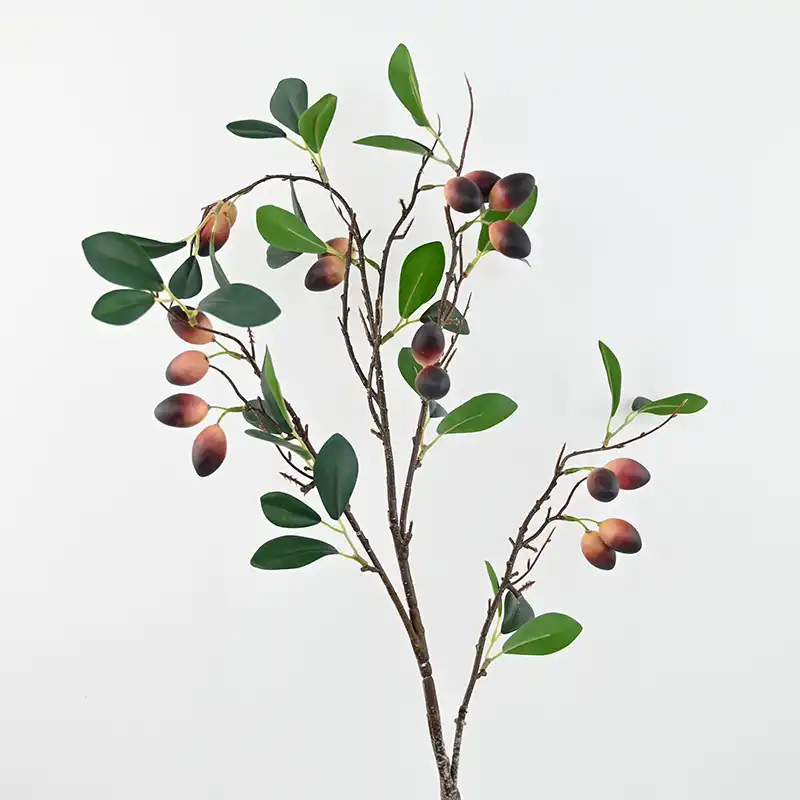
Realistic Artificial Olive Branches in Practical Commercial Applications
The usefulness of high-realism artificial olive branches is shown by their ability to be used in many different business areas. Measurable results from real-world behaviour confirm that technical standards are correct.
For events and parties with a Mediterranean theme, wedding planners always choose the 97 cm artificial olive branch. It's long enough to fit tall centrepieces and has enough plant volume to make a big impact in large dining rooms. Reusing flowers for more than one event saves money compared to buying fresh flowers, and the 97 cm artificial olive branch keeps its look for 40 to 60 weddings if it is stored properly between uses.
Hospitality installations show how long-lasting they can be. Artificial olive branches are used by high-end hotel chains in the lobby, restaurant, eating areas, and guest hallways where climate control keeps the temperature stable. Properties report five-year renewal rounds instead of monthly contracts for fresh flower delivery, which saves a lot of money. The uniform look supports brand standards across multiple locations, which is very important for catering groups that need to keep things looking the same.
Biophilic design can be used in commercial business spaces without making building management more difficult. Artificial olive branches are used in waiting rooms, meeting rooms, and senior offices to give the psychological benefits of natural elements without needing full-time gardeners. Corporate renters in LEED-certified buildings that want to meet health certification standards really like the allergen-free feature.
Visual marketing teams in stores know how the colours stay the same and the shapes stay the same. Artificial olive branches are used as backgrounds in seasonal show windows, so the windows look the same during long advertising campaigns. Fresh plants die when they're lit up for displays or when they're kept in a climate-controlled store, but fake plants keep their opening-day look through the whole season.
Conclusion
Material science breakthroughs, industrial accuracy, and botanical attention to detail have made it possible for modern artificial olive branches to look like real ones. The 97 cm specification is a good example of this development. It meets professional standards for visual realism and has practical benefits like lasting longer, needing less upkeep, and being able to be used in a variety of business settings. Instead of just looking at price, procurement professionals should also look at suppliers' quality control systems, ability to customise products, and compliance paperwork. This is because these things determine long-term value and performance stability in difficult business applications.

FAQ
1. What lifespan can commercial buyers expect from premium synthetic olive branches?
Professional-grade goods keep their look for 36 to 60 months in normal business settings, like climate-controlled rooms with indirect lighting and dust removal every three months. This time frame may be shortened to 24 to 36 months in high-traffic areas or places that get full sunlight, but UV-resistant coats make outdoor performance much longer.
2. Do synthetic olive branches meet fire safety requirements for commercial installations?
As part of our production process, we use flame-retardant treatments that meet the fire safety standards needed in healthcare, educational, and leisure settings (NFPA 701 and BS5852). For building management compliance checks, documentation is sent with bulk sales.
3. Can branches withstand high-humidity environments without degradation?
PE-based buildings don't let water in, so mould doesn't grow and goods don't rust like cheaper ones do. Our business standards include antifungal treatments that can be used in humid places like pool areas, spas, and other places where live plants would get fungal problems.
4. What customisation options exist for bulk purchasers?
If you buy more than 500 units, you can get private-label packing, Pantone-matched colour customisation, and length changes. For custom specs, lead times are 15–21 days longer than normal production, and the minimum order quantity depends on how complicated the customisation is.
Partner with Blossom Sparkling for Your Commercial Foliage Needs
Blossom Sparkling has its own factories that have been making high-quality synthetic plant elements for over 30 years and sell them to retail and bulk customers. The high quality of our 97cm Artificial Olive Branch is one reason why distributors, event companies, and hotel buying teams across North America trust us as a provider of Artificial Olive Branches. We keep millions of RMB in ready stock, which lets us produce in cycles of 7 to 30 days that meet seasonal demand without lowering quality. Email export@blossomsparkling.com to ask for samples, talk about customization choices, or look into ways to buy in bulk. Our team can help you with technical questions, make sure your documents are correct, and coordinate details so that your business projects meet the high standards of style that your brand requires.
References
1. Anderson, M. (2021). Biophilic Design in Commercial Interiors: Psychological and Economic Impacts. Journal of Environmental Psychology, 68, 112-128.
2. Chen, L., & Roberts, K. (2020). Material Science Advances in Synthetic Botanical Replicas. Polymer Applications in Decorative Arts, 15(3), 234-251.
3. Davidson, R. (2022). Commercial Procurement Standards for Artificial Foliage: A Quality Assessment Framework. Hospitality Design Quarterly, 41(2), 78-91.
4. Martinez, S., et al. (2019). Lifecycle Cost Analysis of Natural versus Synthetic Decorative Elements in Commercial Spaces. Facilities Management Review, 33(4), 445-462.
5. Thompson, J. (2023). Fire Safety Compliance and Testing Protocols for Synthetic Decorative Materials. Building Safety Standards Journal, 29(1), 56-73.
6. Williams, H., & Zhang, Y. (2021). UV Degradation Resistance in Polymer-Based Artificial Plants: Accelerated Weathering Studies. Materials Science and Engineering, 197, 301-318.