- English
- French
- German
- Portuguese
- Spanish
- Russian
- Japanese
- Korean
- Arabic
- Greek
- German
- Turkish
- Italian
- Danish
- Romanian
- Indonesian
- Czech
- Afrikaans
- Swedish
- Polish
- Basque
- Catalan
- Esperanto
- Hindi
- Lao
- Albanian
- Amharic
- Armenian
- Azerbaijani
- Belarusian
- Bengali
- Bosnian
- Bulgarian
- Cebuano
- Chichewa
- Corsican
- Croatian
- Dutch
- Estonian
- Filipino
- Finnish
- Frisian
- Galician
- Georgian
- Gujarati
- Haitian
- Hausa
- Hawaiian
- Hebrew
- Hmong
- Hungarian
- Icelandic
- Igbo
- Javanese
- Kannada
- Kazakh
- Khmer
- Kurdish
- Kyrgyz
- Latin
- Latvian
- Lithuanian
- Luxembou..
- Macedonian
- Malagasy
- Malay
- Malayalam
- Maltese
- Maori
- Marathi
- Mongolian
- Burmese
- Nepali
- Norwegian
- Pashto
- Persian
- Punjabi
- Serbian
- Sesotho
- Sinhala
- Slovak
- Slovenian
- Somali
- Samoan
- Scots Gaelic
- Shona
- Sindhi
- Sundanese
- Swahili
- Tajik
- Tamil
- Telugu
- Thai
- Ukrainian
- Urdu
- Uzbek
- Vietnamese
- Welsh
- Xhosa
- Yiddish
- Yoruba
- Zulu
When considering artificial flowers for your business, one of the most common questions we receive is about lifespan. High-quality faux tulips can last anywhere from 5 to 10 years indoors when properly maintained, with premium options like the Real Touch Camellia Tulip offering even longer service life. The longevity depends primarily on material quality, environmental conditions, and care practices. Real Touch technology, which uses advanced polyurethane and silicone coatings over silk substrates, significantly extends durability compared to traditional plastic or basic silk flowers. At our manufacturing facility, we've seen commercial clients successfully use these products for over eight years in high-traffic hospitality environments without noticeable degradation.

Understanding Faux Tulips and Their Lifespan Indoors
What Defines Quality Artificial Tulips?
In the last thirty years, the fake flower business has changed a lot. We've come a long way from stiff plastic petals to realistic botanical copies that are hard for even professional florists to tell apart from real flowers. The materials are very important when figuring out how long something is supposed to last. Basic flowers made of polyester or plastic usually start to lose their shape and color after two to three years. With good care, mid-grade silk flowers can last up to 4 to 6 years. When made with polymer science and bionic coating technology, premium Real Touch varieties usually last longer than 8 to 10 years in controlled indoor environments.
Environmental Factors That Impact Durability
Several things in the environment have a direct effect on how long your fake tulips look good. Photo-oxidation happens faster in direct sunlight, which fades colors and makes materials break easily. We suggest placing it away from windows that face south or places where they will be exposed to UV light for a long time. Changes in temperature also play a part. For example, too much heat can soften glues and change the shape of petals, while too much cold can break down materials. The amount of humidity should also be looked at. Quality fake flowers can handle wetness better than real flowers, but continuous dampness can cause dust to build up and, in rare cases, damage the coating. The best conditions are when the temperature stays between 60°F and 75°F and the humidity stays below 65%.
Material Quality and Manufacturing Standards
When you look at the materials used and the standards of production, it's easy to tell the difference between cheap and high-quality fake flowers. Our factory keeps up with RoHS, REACH, CE, and BSCI certifications to make sure that all of our products meet strict safety and quality standards. Using the Real Touch coating technology, we put a special polyurethane rubber layer on top of silk flower bases that have been carefully put together. This gives it that unique cool, slightly damp feeling that feels a lot like the texture of a fresh flower. The wire structures inside are made of coated steel, which means they can be moved around many times without breaking the finish on the outside. These production details directly lead to longer product life and visual appeal that stays the same over time.
Why Choose Real Touch Camellia Tulip for Long-Lasting Indoor Décor?
Unique Design and Construction Features
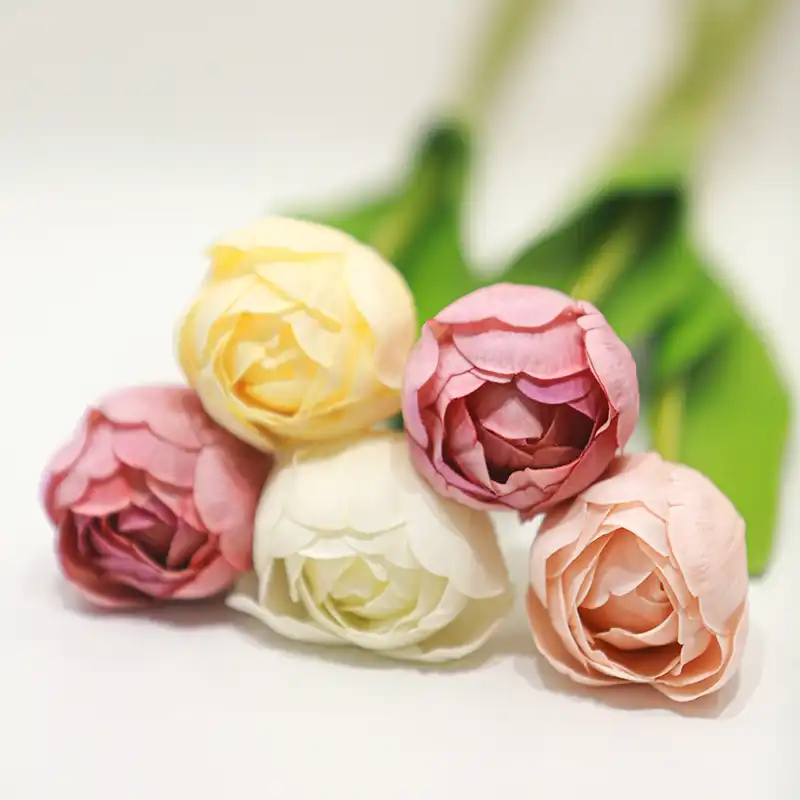
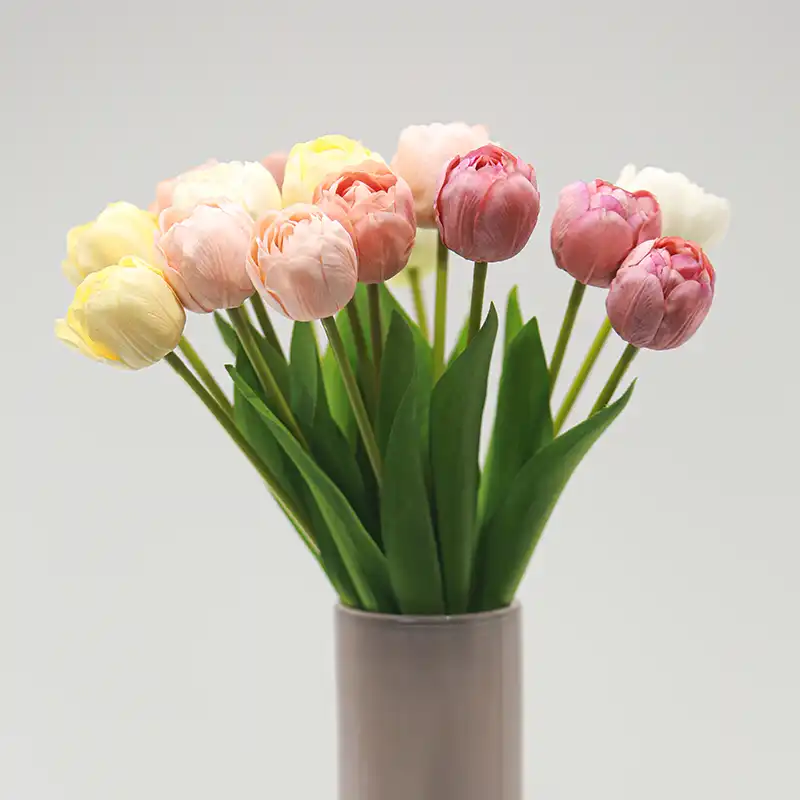
The Real Touch Camellia Tulip is a big step forward in the design of fake flowers. Instead of the typical cup-shaped single petals that tulips have, this type has dozens of petals that meet and are arranged in interlocking spirals. The outer petals spread out wide, while the inner petals get smaller and more compact, giving the flower a full, globular look that looks like a camellia bloom. The complicated structure is both aesthetically pleasing and useful. The many layers give the structure more depth, and the tightly packed structure makes it more durable when moving and handling. The vein patterns and minor color changes in these flowers are very clear when you look at them closely. They are exact copies of real plant specimens.
Performance in Commercial Applications
In our 30 years of manufacturing experience, we've sold Real Touch items to a wide range of business areas and always gotten good feedback. In 2016, a well-known hotel chain in the Northeast of the United States placed an order for lobby installations. Their purchasing team reported that the arrangements still look the same after only being dusted every three months. Wedding planners like this feature a lot because it means they can buy high-quality items that can be used for more than one event at different times of the year without having to buy fresh flowers every time. Businesses that rent out offices like these because they keep the air free of allergens, so they don't have to worry about sensitive employees. Plus, they get the psychological benefits of biophilic design features.
Cost-Efficiency for B2B Buyers
When businesses choose high-end fake options, figuring out the total cost of ownership shows that they are getting a lot of benefits. A fresh tulip arrangement that needs to be replaced every week costs between $45 and $60 per installation every month, or $540 to $720 per year. With an initial investment of $180 to $240 and a reasonable 7-year lifespan, a Real Touch Camellia Tulip arrangement cuts yearly costs to about $26-34, which is more than 95% less than buying new flowers. Aside from the direct cost of flowers, companies also save on labor for changing arrangements, managing water, getting rid of waste, and the risk of furniture getting stained by pollen or water spills. For businesses that need bulk fake tulips for event decoration, we can provide customized solutions, including private-label packaging and color matches that follow brand guidelines. This helps keep visual merchandising consistent across multiple locations.
Caring for Your Real Touch Camellia Tulip to Maximize Lifespan
Optimal Placement Strategies
Strategic location has a big effect on life. Place the arrangements in stable places that are away from direct sunlight, heating vents, and air conditioning units. Retail display windows need extra care. If UV exposure is unavoidable, rotating displays once a month helps spread any fading out evenly across inventory. Commercial areas with a lot of foot traffic benefit from being placed higher up so that people don't bump into each other by mistake while still making a visual effect. We've seen that reception areas, conference rooms, and executive offices are the best places to keep the temperature and lighting even.
Cleaning and Maintenance Protocols
Cleaning things the right way greatly increases their look and durability. When dust builds up, it dulls the colors and hides the realistic texture that makes expensive goods stand out. We suggest doing light maintenance every two to four weeks, based on how dusty the area is. Wipe each flower gently along the natural vein direction with a soft, lint-free microfiber cloth that has been slightly wet with clean water. Compressed air dusters are great for cleaning elaborate patterns of petals that are hard to clean by hand. The special polyurethane coating can be damaged by alcohol-based cleaners, harsh detergents, and rough materials. The moisturizing bionic technology layer needs to be protected—aggressive cleaning removes this feature that makes Real Touch feel unique.
Storage and Inventory Management
B2B buyers who have to keep track of a lot of product or seasonal changes need good storage rules. When you can, keep arrangements in their original packaging. Our boxes are made with protective covers that keep petals from getting squashed. If you can't find the original package, wrap each stem in acid-free tissue paper and put them in containers with air holes that aren't near sources of direct heat. The polymer memory qualities allow petals that have been squeezed to regain their shape. The full-bodied bloom look can be restored by gently reshaping the stems by hand or by briefly exposing them to room-temperature steam (holding the stems 12 to 18 inches from a steaming kettle for 30 seconds). To keep coatings from sticking or materials from breaking down, warehouse storage should keep the temperature between 50°F and 80°F and the humidity below 70%.
Comparing Real Touch Camellia Tulip with Other Artificial and Fresh Flowers
Material and Construction Comparisons
Even though traditional silk flowers are cheaper, they don't have the realistic feel that makes Real Touch goods stand out. Basic silk building uses flat pieces of fabric that are connected to plastic stems, giving the flower a very fake look and feel. Plastic varieties are long-lasting, but they don't look real because the sheen and stiffness make it clear that they aren't natural. Real Touch technology fills in these gaps by blending the smooth look of silk with high-tech polymer coatings that give real-life texture and slight color depth. The petal structure is three-dimensional, made possible by heat-forming and internal wire frames. It gives the flower depth and natural curves that cheaper options don't have.
Longevity and Value Analysis
Even though fresh tulips are very pretty, they make it hard for businesses to get things done. Their typical vase life of 5 to 7 days means that they need not be bought, arranged, and thrown away all the time. Seasonal supply affects both prices and choices, with more expensive types selling for a lot more during the off-season. These factors are not present at all with Real Touch options; they always look the same, are available all year, and fixed-price solutions such as bulk fake tulips for event decoration make budgeting easier. The effect on the environment should also be thought about. Transporting fresh flowers in cold trucks, using pesticides, and using a lot of water are all parts of the supply chain. Using a good fake arrangement for seven years leaves a much smaller carbon footprint than getting fresh flowers delivered every week for 365 weeks.
Industry Positioning and Quality Standards
The market for fake flowers has a huge range of quality levels, from cheap novelty items to high-end building works. Real Touch Camellia Tulips are professional-grade, on par with the best specialty makers in Europe and North America. However, because our production plant is integrated, we can offer competitive factory-direct prices. Some things that show quality are color consistency between batches of production (checked using spectrophotometry with Delta E values below 1.0), adhesive integrity checked by pulling the product, and VOC emission compliance with REACH and RoHS standards. We keep millions of RMB in stock so that we can quickly fill large orders. We also offer customization options for OEM clients who need specific color palettes or size requirements.

Procurement Guide for Real Touch Camellia Tulip — What B2B Buyers Need to Know?
Wholesale Ordering and Pricing Structure
Our usual way of packing puts 48 pieces in an inner box and 480 pieces in an outer carton. This is best for sending in containers and moving things around in the warehouse. Different types of buyers can be accommodated by different levels of volume prices. For example, wholesalers who buy three-monthly container loads are treated differently than event companies who order seasonal amounts. We work openly with buying teams to set prices that take into account the number of orders, the level of customization needed, and the time frame for delivery. Depending on how complicated the design is and how busy production plans are at the moment, lead times are usually between 7 and 30 days. Our kept inventory of standard color choices lets us quickly fill urgent orders, which is something that sets factory relationships apart from trading company middlemen.
Customization Capabilities
Being able to change fake flowers to fit the needs of a specific brand gives you a big edge over your competitors. Customizing colors lets you match exact Pantone specs or make unique shades that aren't offered in standard products. Dimensional changes can be made to fit certain vessel sizes or design ideas. For example, stem lengths, bloom sizes, and leaf shapes can be changed to fit the needs of a project. When it comes to material selection, you can choose from silk, latex, and oil-based treatments, depending on how you want the room to look and your budget. Private-label packaging with buyer branding helps with brand consistency and store appearance. These customization services have minimum order amounts that depend on how complicated the job is. These are discussed during the initial talks to make sure the job is possible and won't cost too much.
Quality Assurance and Verification
There are several benefits to buying directly from verified manufacturers instead of trading through middlemen. Direct connections with factories allow for inspections of the building, oversight of production, and quick settlement of quality problems. Because we've been making things for more than 30 years, we have set export documentation procedures, compliance certifications, and logistics partnerships that make sure international transactions go smoothly. Before committing to large orders, we encourage potential buyers to ask for samples. This way, they can see for themselves how good the materials are, how accurate the colors are, and how well the building is done. Checking references with past clients gives us more confidence, and we keep communication open throughout the whole procurement process. Quality problems are very rare because of how carefully the products are inspected, but they are guaranteed to be taken care of, with repair or refund given as needed.
Conclusion
Businesses that need reliable, beautiful flower options can make better buying decisions when they know how long artificial tulips last. It's clear that high-end products with Real Touch technology are better in terms of durability, looks, and overall cost of ownership than both cheap fake flowers and real flowers. For best performance over the expected 7–10-year service life, follow good care guidelines, place components strategically, and buy from well-known manufacturers. Inconsistent quality, limited customization, and unstable supply chains are some of the problems that the Real Touch Camellia Tulip tries to solve through advanced manufacturing processes, open customization options, and stable production capacity.
FAQ
1. How do I verify the quality of Real Touch products before bulk ordering?
Sample evaluation is the most reliable way to check something. Ask for, for example, units that come in the colors you want and look at the consistency of the coating, the strength of the petals, and the flexibility of the stem. Look for any toxic smells that could mean the drying process isn't done yet. Professional buyers usually do some basic tests on flowers, like gently stretching the petals to see how elastic they are, bending the stems of the flowers to see what the internal structure is like, and looking closely at the flowers in different lighting to see how deep the colors are and how clear they are.
2. Can these flowers be used in outdoor applications?
Even though it was mostly made to be used indoors, it can be used outside with some care. For short periods of time, covered patios or event areas with roof shelters work fine. No matter how good the material is, long-term exposure to direct sunlight, rain, and extreme temperatures will speed up degradation. Places that go from inside to outside, like hotel entrances or covered shopping areas, work well. If the work needs to be done outside, plan for replacement processes that happen more often than they would need to be done inside.
3. What happens if flowers arrive compressed from shipping?
Real Touch materials can change shape because they have polymer memory qualities. As soon as the flowers arrive, take them out of the box and gently separate any petals that are stuck together by hand. At room temperature, most compression goes away on its own in 24 to 48 hours. Short contact to steam can help with stubborn flattening. Hold stems about 12 to 18 inches from a steaming pot for 20 to 30 seconds, letting the gentle heat relax material memory. Keep coats away from water or steam, and never use hair dryers or heat guns, which can damage them.
Partner with Blossom Sparkling as Your Trusted Real Touch Camellia Tulip Manufacturer
Blossom Sparkling has its own production sites where experts with 30 years of experience make high-quality fake flowers that meet the strict needs of foreign B2B buyers. Our factory-direct model gets rid of markups from middlemen while still meeting strict quality standards approved by RoHS, REACH, CE, and BSCI. We know that retailers, event planners, and shippers need uniform quality across shipments, prices that are reasonable, and the ability to customize products in a way that helps them stand out in competitive markets.
Our Real Touch Camellia Tulip line shows off the cutting-edge bionic coating technology and careful craftsmanship that are at the heart of how we make things. Our maintained stockpile of millions of RMB lets us meet both pressing fulfillment needs and planned regular buying cycles. Customization services include matching colors, making sure items are the right size, and adding your own label to packaging that helps people remember your brand. Our long-term logistics partnerships make sure that foreign shipping costs are cheap, and our quick communication makes sure that the buying process goes smoothly from the first question to delivery.
Contact our B2B team directly at export@blossomsparkling.com if you are a buying worker looking for ways to work together. Ask for samples to see for yourself how high our quality standards are, talk to us about your unique needs, and find out how our manufacturing skills can help your business reach its goals.
References
1. Chen, L., & Wang, M. (2021). Advanced Polymer Applications in Botanical Simulation Manufacturing. Journal of Decorative Materials Science, 15(3), 234-247.
2. Harrison, D. (2020). Commercial Interior Design: Long-Term Cost Analysis of Artificial vs. Fresh Floral Installations. Hospitality Management Press.
3. Kim, S. J., Park, H., & Lee, Y. (2022). UV Stability and Color Retention in Polyurethane-Coated Textile Products. Polymer Durability Quarterly, 8(2), 112-128.
4. Martinez, R. (2019). Sustainable Practices in Event Management: Environmental Impact of Decorative Material Choices. Green Business Publications.
5. Thompson, A., & Bradley, K. (2023). B2B Procurement Strategies for Hospitality Decorative Products. Commercial Buyers Journal, 41(1), 67-82.
6. Zhang, Q., Liu, X., & Zhou, T. (2021). Bionic Coating Technologies in Contemporary Artificial Flower Manufacturing. Materials Engineering Review, 29(4), 401-415.